CONFESSIONS OF A FREEDOM FIGHTER HOW TO DEFEAT THE NEW WORLD ORDER

THE MOST STRATEGICALLY CENSORED PERSON ON THE PLANET
Since the early days of the Internet, David DeGraw has been censored, hacked and suppressed in many nefarious ways. Yet, time and time again, he has courageously persisted in finding ways to break free from the chains to expose corruption at the highest levels and launch movements for justice. His strategic network of alliances throughout the Intelligence Community, military and politics, including a wide diversity of thought leaders, artists and activists with opinions across the entire political spectrum, has made him an undeniable force to be reckon with. It is hard to imagine that anyone has a more in-depth understanding of the attacks against us in combination with the ability to unite people for strategic counter-measures more effectively than David. He has fearlessly led the charge on all of the issues listed below.
Here are 35 of his career highlights, in chronological order, 1992 – 2022:
1. The Bank of Credit & Commerce International (BCCI) scandal – revealing over a decade of CIA covert funding of almost every evil imaginable, including but not limited to: the Savings & Loan scandal; stock market manipulation, global money laundering; Iran-Contra Affair; Iran hostage crisis; Iraqgate-BNL, funding Saddam Hussein; Pakistan’s nuclear program, bomb-making technology to Libya, Iran & North Korea; funding of Osama bin Laden & Al Qaeda network; global weapons black market; support of terrorism worldwide; international drug trade run by people like Noriega & Escobar, global sex trafficking, management of prostitution, political bribery, entrapment, manipulation of elections, tax evasion & illegal immigration. As the U.S. Senate Foreign Relations Committee on Terrorism, Narcotics and International Operations investigation summed it up: BCCI’s criminality was “limited only by the imagination of its officers and customers.” The CIA ran the bank & the DoJ, FBI, leadership of both parties & the mainstream media covered it up for over a decade, none of the major players were held accountable;
2. CIA facilitation of crack cocaine epidemic throughout U.S. inner cities, research for Gary Webb’s Dark Alliance investigative series;
3. History & evolution of propaganda, PR, marketing, Psychological Operations & behavioral sciences – first book in 1996, The Art of Mental Warfare: Deconstructing the Technocratic Complex;
Against the Great Reset: Eighteen Theses Contra the New World Order HARDCOVER...
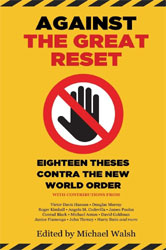
Much more than a collection of essays by eminent writers, Against the Great Reset is intended to kick off the intellectual resistance to the sweeping restructuring of the western world by globalist elites.
InJune 2020, prominent business and political leaders gathered for the 50th annual meeting of the World Economic Forum in Davos, Switzerland, under the rubric of “The Great Reset.” In the words of WEF founder Klaus Schwab, the Great Reset is a “unique window of opportunity” afforded by the worldwide COVID-19 panic to build “a new social contract” ushering in a utopian era of economic, social, and environmental justice. But beneath their lofty and inspiring words, what are their actual plans?
In this timely and necessary book, Michael Walsh has gathered trenchantcritical perspectives on the Great Reset from eighteen eminent writers and journalists from around the world. Victor Davis Hanson places the WEF’s prescriptions and goals in historical context and shows how American politicians justify destructive policies. Michael Anton explains the socialist history of woke capitalism. James Poulos looks at how Big Tech acts as informal government censors. John Tierney lays out the lack of accountability for the unjustified panic over the virus. David Goldman confronts the WEF’s ideas for a fourth industrial revolution with China’s commitment to being the leader of a post-western world. And there are many more.
These writers see the goal of the Great Reset as not just a world without racism, disease, economic inequality, or fossil fuels—but rather, a world with no individual autonomy and power in which our betters rig the system for their own purposes. Find out what the Great Resetters ultimately have in store for you, and join the intellectual resistance—before it’s too late.
Featuring Essays by:
Michael Anton
Salvatore Babones
Conrad Black
Jeremy Black
Angelo Codevilla
Janice Fiamengo
Richard Fernandez
David P. Goldman
Review by Barns and Noble
In God We Trust: Not In Lying Liberal Lunatics:
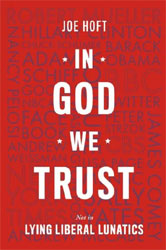
After seven years of the Obama Administration, the US was broken. Americans wanted change and they got it with the Presidency of Donald J. Trump. But the corrupt and dishonest media, Democrat politicians (and some Republicans), and 'Deep State' actors in the government, didn't want Trump in power. These entities and individuals are killing the country and destroying the freedom and justice promised to all Americans.
You will be shocked at the level of corruption in the US today. This book will open your eyes and inform you of the many corrupt actions taking place that are destroying the USA.
Stories about Crowdstrike, Concord Management, Schifty Adam Schiff, the Mueller gang and social media targeting conservatives are discussed in detail. These are stories that the 'MSM' will never touch and will shock you.
'New media', along with changes in the government are the answer. Americans want the truth and this book will give it to you! After reading "In God We Trust - Not in Lying Liberal Lunatics", you will never be the same.
Terminated The End of Man is Here Humanity on the Bank of Extinction
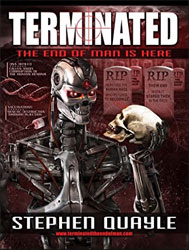
Incredible future events for mankind! This book is full of future events that the human race has no idea is coming upon the populations, and can't conceive of given the vast amount of "deception" that has permeated most of the entire human race. The most informative book, quite frightening but not surprising in this era. A must read for sure. Indispensable, enlightening and impactful. fluid and grounded writing.
U.N Agenda 21: Environmental Piracy
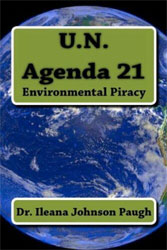
U.N. Agenda 21 has been in the works for decades, spearheaded by environmentalists, foreign individuals, third world countries, and non-profit organizations around the world. In the name of protecting the environment, socialist global governance has been quietly implemented at all levels of government via government grants, public-private partnerships, and EPA regulations involving use of land and water, affecting every facet of our lives.
Mandating population re-distribution in the name of biodiversity, re-educating our youth into sustainable everything, green jobs, green buildings, green cars, green energy, urban sprawl control, government bureaucrats from the United Nations and our own elected representatives are going to rezone us, resettle us, reduce our numbers, and tax us into the sustainable community described in the Wildlands Project Map.
Forcing us out of cars, into bike paths, light rail, walkways, greenbelts, ever more conservation areas forbidden to humans, urban boundary zones, and high-density areas, U.N. Agenda 21s 40 chapters will limit the behavior of individuals, organizations, and companies, covering everything we do in life. U.N. Agenda 21 and has been implemented administratively with help from ICLEI and little Congressional debate or involvement. Some of the provisions of U.N. Agenda 21 have been included in other laws passed. Presidential executive orders are forcing its implementation at the national level.
Our sovereignty is at stake. We must stop U.N. Agenda 21 before it is too late. Every chapter of it violates our Constitution.
1984 by George Orwell
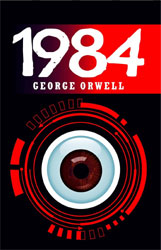
1984 written by George Orwell in 1949. The story takes place in London in the year 1984, but it could be anywhere. Orwell describes a dystopian nightmare future for humanity. A world of crushing authoritarianism and harsh punishments. The tellescreen watches everyone always and there is no freedom of speech, no freedom to love or to have real friendships. Total societal control and the control of language are the goals of a tiny handful of unseen ruling elites, who hide behind the persona- Big Brother: "If you want a vision of the future, imagine a boot stamping on a human face - forever" - George Orwell
The main character, Whinston, lives under constant observation by a tellescreen in his tiny apartment unit provided by the state. Whinston follows every command from the tellescreen, to refuse would mean deprogramming and death. He works in the 'Ministry of Truth' where his job is to edit news and information meant for public consumption. Whinston dutifully removes all information that doesn’t fit Big Brother’s narrative of reality. In the social order Whinston is at the bottom of the power structure, but still a part of it. There are others in society at much lower socioeconomic tiers like the Proles. Sometimes Whinston wishes he was a Prole because in their abject poverty they enjoy interpersonal relationships, something forbidden to him.
Whinston questions Big Brother and the cold empty reality created for humanity to live in. He wants to experience more, which is very dangerous for him, but his thirst for life outweighs his fear of punishment and death. And so his terrible adventure begins, and in the end he learns the truth.
COVID-19 and the Agendas to Come, Red-Pilled
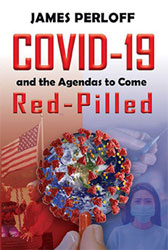
Drawing on statements of numerous scholars from around the world—virologists, epidemiologists, immunologists, pathologists, microbiologists, infectious disease specialists, including Nobel Prize winners, as well as front-line ER physicians and family practice MDs—veteran journalist James Perloff asks hard questions about the global response to COVID-19.
—Are the virus’s health risks greater than those posed by the lockdowns?
—What does the science say about masks and social distancing?
—Why were no lockdowns imposed for previous pandemics of comparable magnitude?
—How accurate are the death numbers attributed to COVID-19?
—Is the virus completely natural, or could bio-engineering have played a role?
—Should the world’s population take a COVID vaccine developed at “warp speed?”
—Why is Bill Gates formulating health policy, even though he has no medical credentials?
—How might a “second wave” be different?
—Is the COVID crisis being exploited to push us into an Orwellian future of mass surveillance, digital IDs and cashless transactions?
Perloff draws from mainstream publications and official government sources such as the CDC, as well as independent researchers whose work is increasingly hard to find online due to censorship by tech giants like FaceBook, Google and YouTube.
------------------------
Around the time Twitter purged New York Post's bombshell stories about Hunter Biden from its platform, late last week, Amazon was busy censoring any criticism against the "official" COVID-19 narrative, with the banning of at least one book from its Amazon Books store.
Political writer James Perloff's latest book, "Covid-19 and the Agendas to Come: Red-Pilled," was removed from Amazon on Thursday, he tweeted.
"BAD NEWS. After selling over 3,500 copies for Amazon since publication on August 20, Amazon has banned my book "COVID-19 and the Agendas to Come, Red-Pilled." Individual orders can still be placed at..." Perloff tweeted.
Book: "Covid-19 and the Agendas to Come: Red-Pilled"
Perloff spoke with RT News about the incident, which he outlined how Amazon's act of censorship validates his book's findings, expressing concern that "the censorship on Covid has been getting progressively stronger, even as the death rate from Covid has been getting progressively lower."
"We are in a truly Orwellian culture," he warned.
United States of Socialism: Who's Behind It. Why It's Evil. How to Stop It.
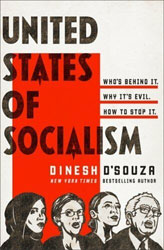
For those who witnessed the global collapse of socialism, its resurrection in the twenty-first century comes as a surprise, even a shock. How can socialism work now when it has never worked before?
In this pathbreaking book, bestselling author Dinesh D’Souza argues that the socialism advanced today by the likes of Alexandria Ocasio-Cortez, Bernie Sanders, Ilhan Omar and Elizabeth Warren is very different from the socialism of Lenin, Mao and Castro. It is “identity socialism,” a marriage between classic socialism and identity politics. Today’s socialists claim to model themselves not on Mao’s Great Leap Forward or even Venezuelan socialism but rather on the “socialism that works” in Scandinavian countries like Norway and Sweden.
This is the new face of socialism that D’Souza confronts and decisively refutes with his trademark incisiveness, wit and originality. He shows how socialism abandoned the working class and found new recruits by drawing on the resentments of race, gender and sexual orientation. He reveals how it uses the Venezuelan, not the Scandinavian, formula. D’Souza chillingly documents the full range of lawless, gangster, and authoritarian tendencies that they have adopted.
United States of Socialism is an informative, provocative and thrilling exposé not merely of the ideas but also the tactics of the socialist Left. In making the moral case for entrepreneurs and the free market, the author portrays President Trump as the exemplar of capitalism and also the most effective political leader of the battle against socialism. He shows how we can help Trump defeat the socialist menace.
The Permanent Coup: How Enemies Foreign and Domestic Targeted the American President
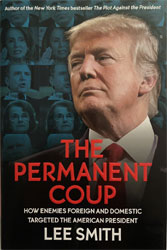
From the phony Russia collusion narrative to the coordinated riots laying waste to US cities, it's the same ongoing operation orchestrated by the left and targeting not just President Trump but hundreds of millions of Americans who revere their country and what it stands for. For the first time, crusading investigative journalist Lee Smith reveals who was responsible and the never before known involvement of Barack Obama, Joe Biden, and senior military officials who engineered a coup against a sitting president.
Beginning in late 2015, political operatives, intelligence officials, and the press pushed a conspiracy theory about Trump-he was a Russian asset and spied on his campaign and his presidency in order to undo an election.
Because the ultimate goal of the anti-Trump operation is not simply to topple the president but rather to change the character and constitution of the country, the Deep State's machinations didn't stop even after Trump was cleared of charges of "colluding" with Moscow. Their efforts became even more fierce, more desperate, and more divisive, threatening to scar America permanently.
In their zeal to bring down President Trump, Deep State conspirators had unwittingly revealed the origins of the anti-Trump operation and exposed corruption at the very highest levels of the Democratic party-including former Vice President Biden and his boss, Barack Obama.
The Death of Liberty: The Socialist Destruction of America’s Freedoms using the Income Tax
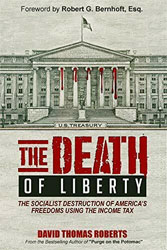
In 1776, the colonists declared Independence from England in large part due to the many onerous Acts thrust upon them by Parliament including the Stamp Act in 1765 the Tea Act in 1773. The combination of these burdensome Acts on the colonies coupled with “Intolerable Acts” that severely limited the colonists Liberties, America rebelled. America won her liberty finally in 1783, only to see American’s freedoms put in a permanent state of peril with the successful progressive class warfare argument that resulted in the 16th Amendment in 1913.
Politicians and government bureaucrats discovered, is they can manipulate the 71,000+ page tax code to reward their cronies and punish their enemies.
The legacy of the IRS is one of scandals, malfeasance, criminality, incompetence and terror – yet Americans, for the most part tolerate it. Why? The history of IRS abuses of common citizens is legendary, and the stories you will read in this book are chilling.
Why has the IRS become “weaponized”, spending $11 million on guns and ammo in the last 10 years? Surely Patrick Henry, Thomas Jefferson and Samuel Adams would have never let such an abusive form of government exist in the United States. Why do we?
| Books |  |