Pages: 1 2 3 4 5 6 7 8 9 10 11 ... 1309 >>
Greedy Grocers Snuff Out Free Speech to Keep Poisoning Us

Garry Turner
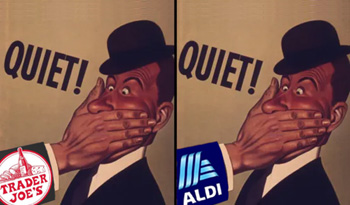
In a disturbing trend that has gained traction in recent years, grocery giants like Trader Joe's and Aldi, along with other members of the grocery cartel, have been actively deplatforming individuals who dare expose the presence of pesticide residues and foodborne illnesses in their products. This insidious practice silences whistleblowers and risks consumers by preventing crucial information from reaching the public eye.
Trader Joe's and Aldi, two popular grocery chains known for their affordable prices and unique product offerings, have come under fire for suppressing free speech regarding food safety issues. These companies have built a reputation for themselves as purveyors of high-quality, organic, and natural foods, but behind the scenes, they seem willing to go to great lengths to protect their bottom line. One such individual who fell victim to this censorship campaign is Tracy Turner, a Horticulturist who spoke out about the company's use of pesticides on its produce. Turner's attempts to raise awareness about the potential health risks associated with these chemicals were met with swift retaliation from Trader Joe's, which launched a coordinated effort to discredit her claims and remove any online content that supported his allegations.
16-year-old high school student suspended for saying the words "illegal alien" while asking a question
Editor thepeoplesvoice.org
A 16-year-old North Carolina high school student was suspended for saying “illegal alien” while discussing word meanings in English class — possibly ruining his chances of landing a college sports scholarship. His teacher had assigned the students to use the word “alien” in a sentence and Christian McGhee asked: “Like space aliens or illegal aliens without green cards?”
The democrats have taken a page from George Orwell's book 1984. In Orwell's prophetic story the global elite wanted to control what people thought. They did this by making common terms in the human vocabulary illegal and so over time these expressions were forgotten. This robbed humanity of the ability to formulate certain ideas and thus the global elite were able to control how people thought and mold society into whatever they wanted it to be.
Iran 1953: MI6 plots with Islamists to overthrow democracy
Mark Curtis
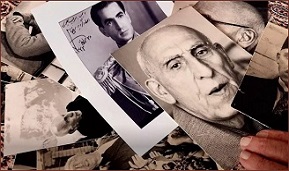
Declassified British files highlight a little-known aspect of the joint MI6/CIA coup against Iran’s democratically elected government in August 1953 – UK covert action in support of leading radical Shia Islamists, the predecessors of Ayatollah Khomeini.
● British officials wanted “a non-communist coup d'état” in Iran to install a “dictator” who would promote UK oil interests
● UK and US governments backed Islamist forces to stir up unrest and even considered installing Ayatollah Kashani as a client leader following a coup
In many accounts the CIA is regarded as the prime mover behind the 1953 coup in Iran, yet Britain was the initial instigator and provided considerable resources to the plot, which UK planners named ‘Operation Boot’.
In the early 1950s, the Anglo–Iranian Oil Company (AIOC), or BP as it is now known, was run from London and owned jointly by the British government and private citizens. It controlled Iran’s main source of income, oil, and by 1951 had become, according to one British official, “in effect an imperium in imperio [an empire within an empire] in Persia”. Iranian nationalists objected to the fact that the AIOC’s revenues from oil were greater than the Iranian government’s. Britain’s ambassador in Tehran, Sir Francis Shepherd, had a typically colonialist take on the situation. The declassified files show his writing:
By the Dawn’s Early Light: On the Fall of the Francis Scott Key Bridge
by Ellen Brown
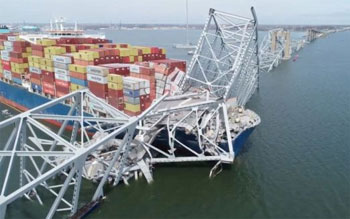
The Baltimore bridge that collapsed on March 26th was named for Francis Scott Key, who wrote the lyrics to the American national anthem “The Star-Spangled Banner” in 1814. His inspiration was the British bombardment of Fort McHenry in the critical port of Baltimore during the War of 1812. The British had just burned the U.S. Capitol and the White House and had set their sights on the Baltimore port, with the guns from hundreds of British ships trained on shelling the American flag. If the flag were taken down, they would know the Americans had surrendered, and the British agreed the shelling would stop. But in the dawn’s early light, the flag still waved, held up by patriots who replaced soldiers who had fallen before them. Francis Scott Key observed all this from a British ship on which he had been allowed on board to negotiate a prisoner release. It is a quite moving story, dramatized here.
What the dawn’s early light brought on March 26, 2024, by contrast, were shocking news videos of the Francis Scott Key Bridge collapsing when the Singapore-owned cargo ship Dali slammed into it. It was “like something out of an action movie,” said Baltimore Mayor Brandon Scott. Several commentators are calling it a “black swan” event that will have catastrophic effects on global supply chains. Interestingly, the War of 1812 was also about disruptions to U.S. trade with foreign nations, in that case by blockade by the British navy. But more on that, and on how our forebears turned dependence on foreign manufacturers into economic independence, after a look at what went amiss with the Dali and the bridge.
11 ways Biden and his handlers are hell-bent on destroying America
Victor Davis Hanson
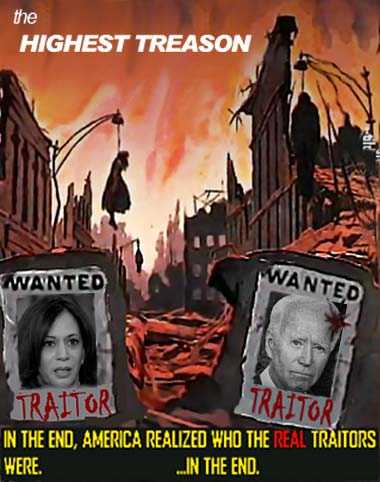
The path to civilizational destruction should be very familiar by now. The Biden administration is 'assaulting the very mechanisms and protocols we use to live'. Why are those controlling President Biden using him to advance so much of a destructive agenda that it will likely end America as we know it? If someone wished to destroy America, could he do anything more catastrophic than what we currently see and hear each day? What would an existential enemy do that we have not already done to ourselves? Historian Victor Davis Hanson tells 'The Bottom Line' the trend is only reversible with a change in leadership.
Here are 11 now familiar steps to civilizational destruction:
1. Wipe out a 2,000-mile border.
Allow 10 million foreign nationals to enter unlawfully. Have no audit of any; nullify all federal immigration laws. Let in toxic drugs that kill 100,000 Americans a year. Give free support to those millions who broke the law. Smear any objectors as racists and xenophobes.
2. Run up $35 trillion in national debt.
Keep adding $1 trillion to it each 100 days. Defame anyone wishing to cut wild spending as cruel and inhumane.
3. Appease or subsidize enemies like Iran and China.
Demonize allies like Israel. Allow terrorists to attack Americans without adequate response. See Islam as either similar or superior to Christianity. Make amends to leftist governments for supposedly past toxic American international behavior. Follow the lead of international agencies like the U.N., ICC and WHO to atone for past American neocolonial and imperialist behavior. Recede to second-tier international status, befitting American decline.
Chicken Licken Finds Safety and Freedom in the Land of Covidia

Once upon a time, there was a little chick called Chicken Licken. One day as she was scratching about in the farmyard, she heard a message coming from the television in the farmhouse saying that everyone must stay home or else we would all die.
‘Oh no,’ cried Chicken Licken. ‘I must go into my coop and stay there.’
So off she went to stay in her coop for three weeks, which was how long the nice man on the telly reckoned it would take. On the way, she met Henny Penny.
‘Oh Henny Penny,’ cried Chicken Licken, ‘There’s a deadly virus about and if we don’t stay cooped up we’re all going to die.’
‘But why would those who are perfectly healthy need to do that?’ asked Henny Penny confused. ‘If we’re healthy, that means we haven’t got it. And if we haven’t got it, we can’t spread it.’
‘Henny Penny!’ replied Chicken Licken aghast. ‘The man on the telly said that healthy people can spread it to one another even if they haven’t got it. Stay Safe.’
‘Sounds like nonsense to me,’ said Henny Penny, ‘but I suppose they must know what they’re talking about.’
Top Virologist Dr. Geert Vanden Bossche Warns of Impending ‘Tsunami’ of Death Among Covid Vaxed

Editor thepeoplesvoice.org
Dr. Geert Vanden Bossche, a world-renowned Belgian virologist, has warned that a massive wave of illness and death among the highly vaccinated population with compromised immune systems is imminent. During an appearance on the KunstlerCast podcast on Friday, Bossche issued a grave warning, stating that “what I am predicting is a massive, massive tsunami” of illness and death among highly-vaccinated populations with compromised immune systems.
Bossche warned that hospitals will collapse, and financial, economic, and social chaos will ensue. He explained that the wave of illness and death will start with more cases of serious long Covid and then replace the surge of cancers, leading to a hyper-acute phase with a huge wave of illness and death.
“What I am predicting is a massive, massive tsunami” of illness and death among highly-vaccinated populations with compromised immune systems, Bossche said.
“You will see what will happen, for example, in the next coming weeks…is more and more cases of more serious long Covid…
“They will start to replace the surge of the cancers…now we have a more chronic phase.
“It will end with a hyper-acute phase, a huge, huge wave…
Rancher Raises Alarm as Feds Begin Bulldozing Texas Farms
Frank Bergman
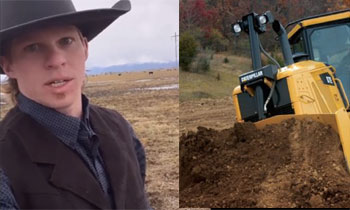
A cattle rancher is raising the alarm after the federal government started bulldozing undamaged Texas farms following the recent wildfires.
In a video message, the rancher, whose identity is not being published, warned that the feds are destroying remaining farms under the guise of clearing damaged lands after the fires. He warns that “over a million acres of farmland” was “burned and ruined” during the Panhandle wildfires. However, the rancher is alerting the public that the government is now “ruining the remaining feed and grasses” that were not harmed by the fires.
“So I wanted to update y’all on what’s going on in Texas, We have over a million acres of farmland that has been burned and ruined. And not only that, we have [the] Texas Forest Service that is going into these ranchers’ properties and dozing up the land. They’re not even dozing the burned areas. They’re ruining the remaining feed and grasses that they do have, and we don’t know why they’re doing this. So let me know what y’all think about this in the comments. Make sure to share this around.” We need to stand up for what’s right. And remember, guys, buy American and buy local.”
This news comes after a separate recent warning from the same rancher about another attack on America’s food supply.
Central Bank Scam is Taking Mankind Down
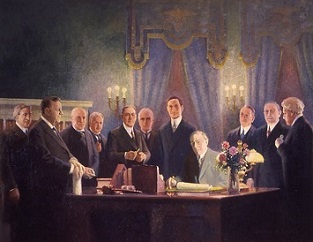
"If we wish to obtain our liberation and sovereignty from the enslavement imposed by the private bankers, we must dismantle ...their central banks or we ourselves shall be destroyed and consigned to oblivion." (A History of Central Banking and the Enslavement of Mankind by Stephen M. Goodson)
Here is a frightening thought. What if mankind were the highest expression of life in the universe? What if God pinned all His hopes on this craven, credulous, lazy, and stupid monkey, man?
What if a powerful satanic cult hijacked the human race? Imagine it displaced God and enslaved the human race in spiritual, mental, and physical bondage. The cult did this by virtue of a very simple scam. It interjected itself between the state and its people by creating the medium of exchange (money) as an interest-bearing debt to itself. Money creation is something the State is perfectly capable of doing itself, without incurring any debt or paying any interest.
This fundamental fraud is the explanation for almost everything that has gone wrong with the world. In order to distract society from the real enemy gnawing at its heart, the central bankers have always created a series of phony enemies and unnecessary wars.
What we learned from the first round of Covid hysteria: Will you be fooled again?

Leo Hohmann
Globalist predators are banking on us having short memories but knowledge is power and we can shut down Covid hysteria 2.0 if we enact Operation Peaceful Non-Compliance
The brilliant constitutional attorney John Whitehead has argued that the U.S. Constitution has “effectively been terminated.” Whitehead first made this observation in a column posted at his website on December 6, 2022. He said it again on July 31, 2023, in an interview with CBN News. The Constitution has been “terminated.” That’s a big statement from a man I trust, and it got me thinking. How did this happen?
What is the Constitution anyway? It’s a legal safeguard, a system of boundaries, meant to protect us against evil doers seeking to take over our society and dominate us. Yes, evil is always present but, at least in America, we had the Constitution and its vaunted Bill of Rights. It was our ultimate firebreak against the tyranny of men.
But after years of infiltration of our major institutions – schools, universities, churches, the media, government – and a couple of major crises in 9/11 and the Covid pandemic — the Constitution was subverted. Where they couldn’t get favorable court rulings, the globalists and their useful idiots (minions) found work-arounds, cleverly claiming they had extra-constitutional “emergency” powers. The legislative branch, Congress, sat back and allowed this evisceration to happen at the executive level. And once the Constitution had been terminated, all of the other safeguards fell like dominoes.
| Voices |  |